Final inspection, first visit.
The 30-year master in your pocket, setbacks to rapid shutdown.
Cancel anytime. 7-day money-back guarantee.
Real questions. Real answers, with the section cited.
Tap a question. These are frozen answers from the same engine you get in the app.
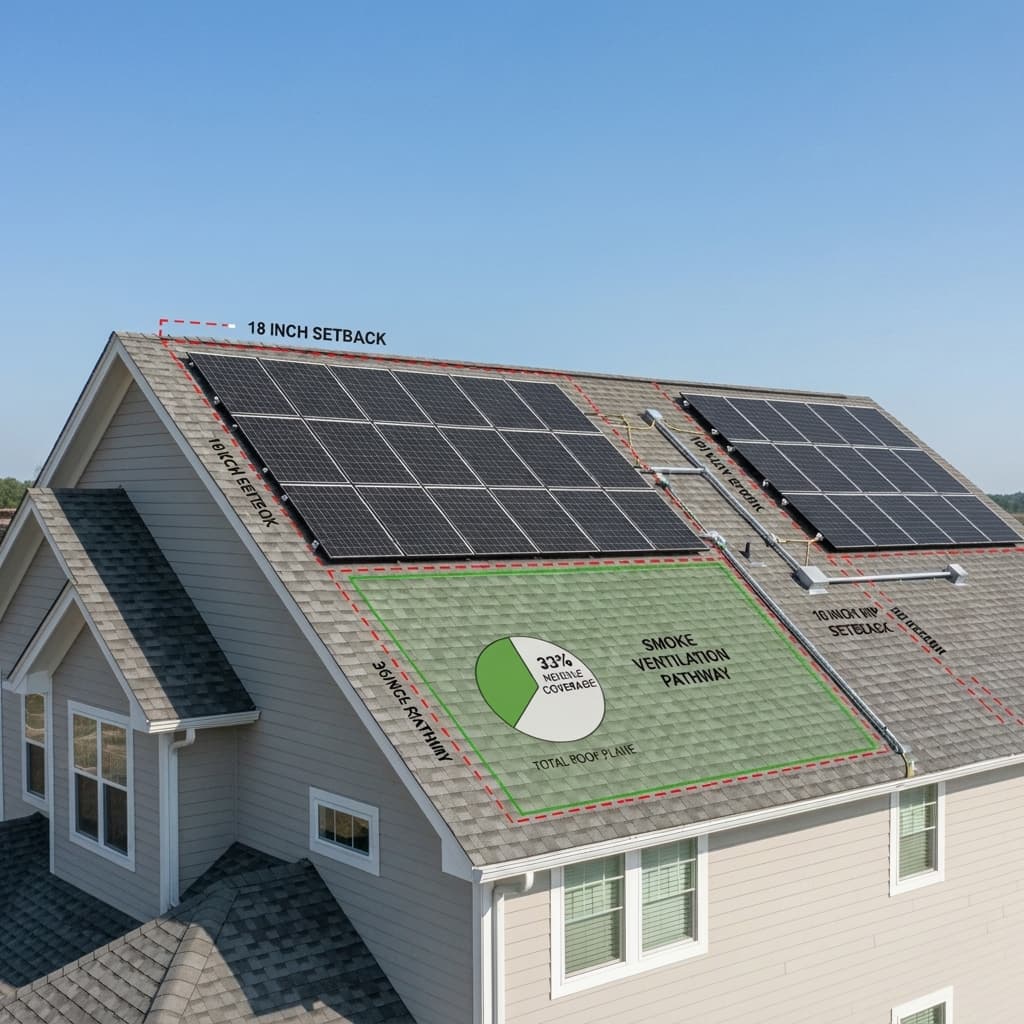
For a one or two family dwelling under the IFC, you need an 18 inch clear setback from the ridge on the side where the array is installed, measured horizontally from the ridge to the top of the modules. That is IFC Section 1205 (2018 and 2021 editions, previously 605.11 in the 2015 IFC). Key points for residential: - 18 inches from the ridge on any roof plane containing modules - 36 inch wide pathway from eave to ridge at minimum, on both sides of a hip roof, or one pathway if there is only one array plane - Hip and valley setback of 18 inches on either side if modules are on both sides of the hip/valley - Pathway width can be reduced or eliminated if the array covers 33 percent or less of the total roof plane and the smoke ventilation criteria are met (2018/2021 IFC) California is the big exception: CRC R331 and Title 24 pull from CA Fire Code Chapter 11B with slightly different pathway rules, and some AHJs there enforce a smaller 18 inch pathway plus specific smoke vent locations. If you are in CA, check the local fire marshal's PV solar guideline document. For commercial (Group other than R-3), the setbacks and pathway widths are larger, generally 4 foot perimeter pathway and 4 foot wide interior pathways spaced per roof area. That is IFC 1205.3 in the 2021 edition. If you are trying to squeeze more panels on and the ridge setback is killing your production, ask whether your AHJ allows the "33 percent coverage" exception, that is where most of the wiggle room lives.